
Smaller fashion brands are not failing because customers are disloyal. They are failing because they do not have enough customers in the first place.
After working with 100+ fashion brands, I keep seeing the same mistake repeated: founders obsess over loyalty programs and retention tactics while their brand bleeds out from lack of reach.
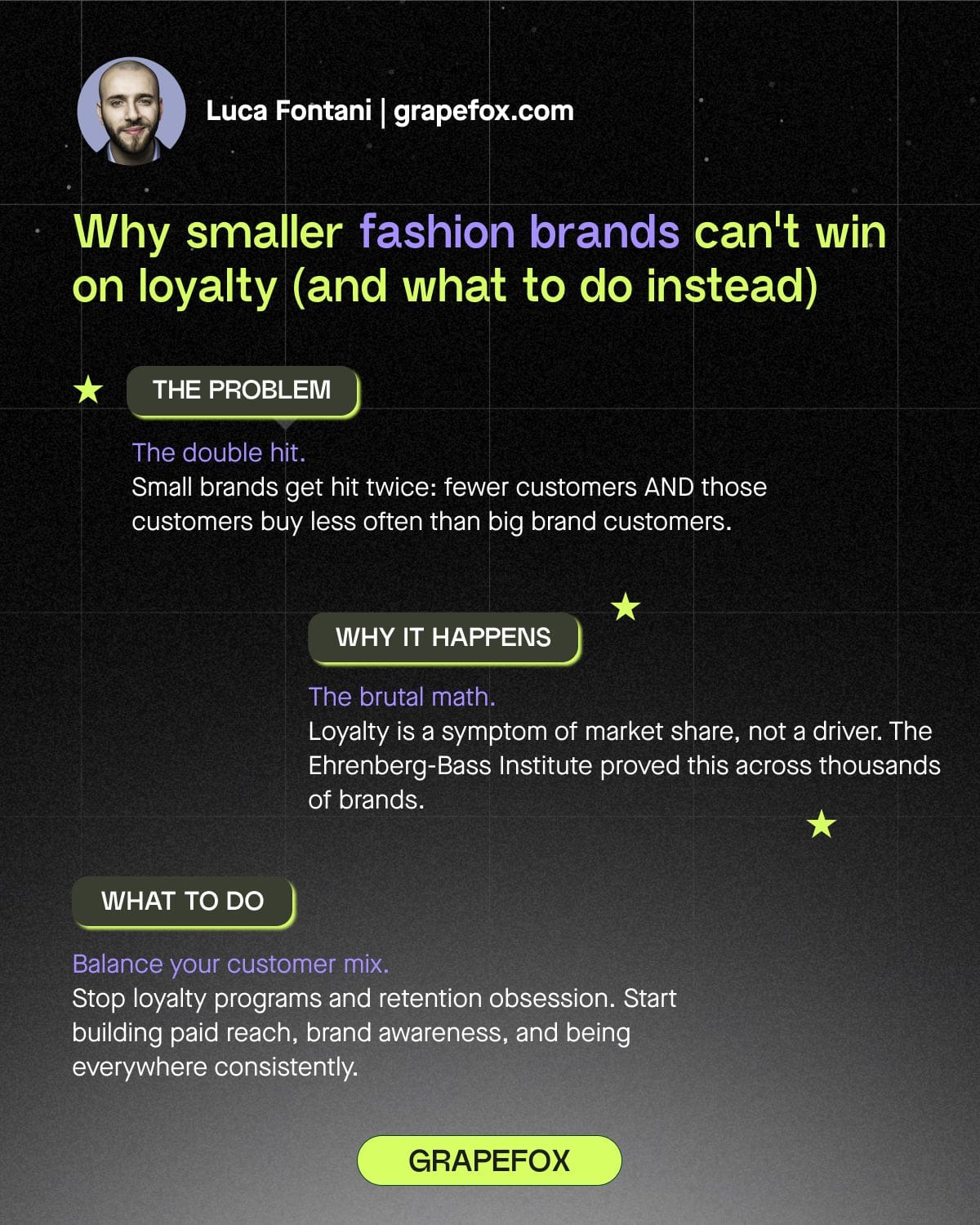
Here is the brutal truth that kills small brands: the double jeopardy law.
How Double Jeopardy Works
Small fashion brands get hit twice:
↳ Fewer people buy from you (low market penetration)
↳ The people who DO buy from you buy less often than big brand customers
Meanwhile, Zara, H&M, and the top 5% of fashion brands have millions of customers AND those customers buy more frequently. This is not coincidence; it is a documented scientific pattern.
The Ehrenberg-Bass Institute (the world’s largest centre for marketing research) has studied this phenomenon across thousands of brands and categories. Their findings are consistent: brand share depends largely on mental and physical availability, rather than differentiated appeals of different brands. In other words, being seen matters more than being special.
The Math is Brutal
Consider two brands competing in the same space:
↳ Brand A (major player): 100,000 customers x 4 purchases/year = 400,000 purchases
↳ Brand B (indie brand): 5,000 customers x 3 purchases/year = 15,000 purchases
You are not just 20x behind in customers. You are 26x behind in total purchases.
This gap compounds over time. Research from the Ehrenberg-Bass Institute confirms that brands that grow do so due to greater acquisition of category buyers, rather than from reducing the defection of existing customers. Their data shows acquisition is roughly twice as important as reduced defection when it comes to increasing market share.
Big brands do not have loyal customers because they are better at retention. They have loyal customers because they are bigger. Loyalty is a symptom of success, not a driver of it.
What Most Fashion Founders Get Wrong
They dump money into:
↳ Loyalty programs that move nothing
↳ Retention campaigns for a tiny customer base
↳ “Community building” while ignoring acquisition
The statistics paint a grim picture. Around 80% of new fashion brands fail within the first five years. Many of these brands fall into the same trap: trying to squeeze more value from a customer base that is simply too small to sustain growth.
Meanwhile, the top brands are everywhere. They are buying reach. They are making it physically impossible NOT to know about them. And thanks to double jeopardy, the more market share they get, the more loyal their customers become; which gives them more cash to buy even more reach.
The cycle compounds. The rich get richer.
So What Do You Actually Do?
Stop trying to squeeze more loyalty out of your 5,000 customers. Start trying to get to 50,000 customers.
Growth comes from penetration, not retention.
That means:
↳ Paid advertising that reaches new audiences
↳ Brand awareness campaigns, not just performance marketing
↳ Being everywhere your competitors are, consistently
The truth? You cannot loyalty-program your way to $20M+ per year. You need more customers. Period.
Ten years in this industry taught me this: small brands die believing they can win on loyalty. Big brands win because they have reach, and loyalty follows automatically.
Stop fighting the wrong battle. Go wide before you go deep.