
Fashion brands keep getting pricing wrong. Here is what it is actually costing them.
One of the most common mistakes we see at Grapefox when auditing fashion brands? They think their margins are healthy because they only look at COGS.
But COGS alone tells you almost nothing.
If you sell through your own e-commerce and handle shipping, returns, packaging, and payment processing; your margins need to reflect all of that. The “last mile.” Every cost.
I audited a fashion brand from the U.S. last week selling at $180 with $75 in COGS.
When I asked about margins, the answer was instant: “We’re at 58%. We’re fine.”
They were not fine.
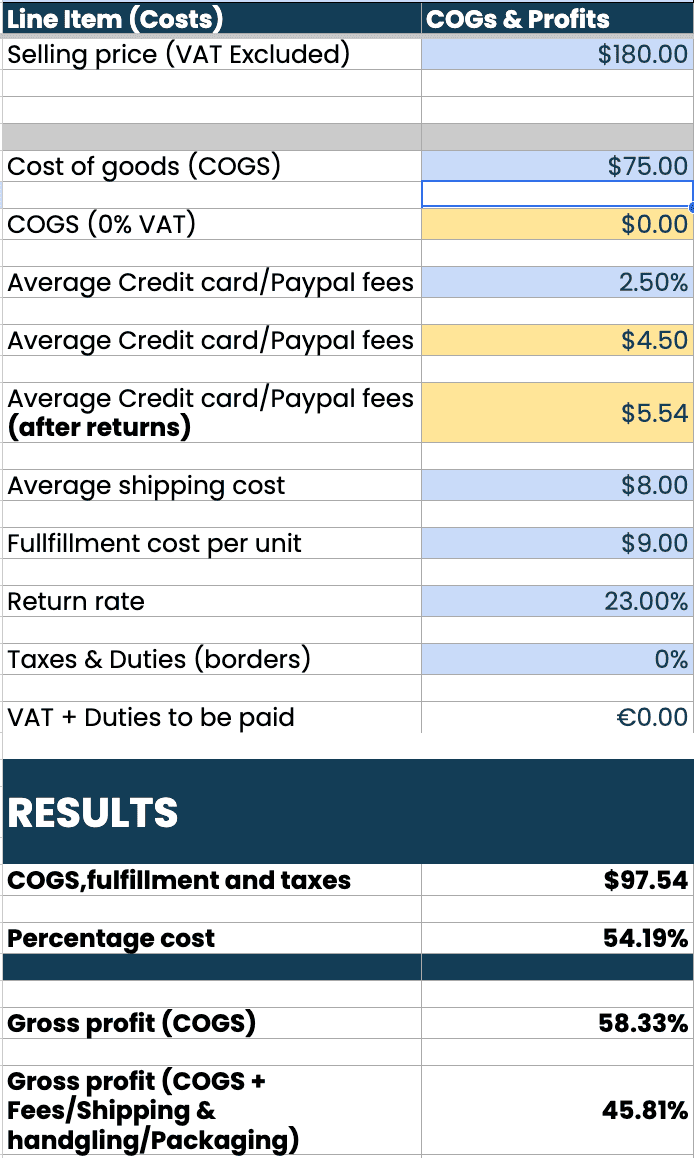
The Real Numbers at $180
Here is what their numbers actually look like at $180:
↳ $75 COGS
↳ 2.5% credit card fees ($5.54 after returns)
↳ $8 shipping
↳ $9 fulfilment
↳ 23% return rate
Gross margin after COGS? 58.33%. Looks decent on paper.
Gross margin after all variable costs? 45.81%.
That is the real number. And it is not enough.
Why 45% Breaks a Business
This is not a theoretical problem. According to a Business of Fashion and McKinsey report, retailers are now paying between $21 and $46 per returned product on average when accounting for shipping, processing, and handling. For a brand already operating at thin last-mile margins, returns alone can erase profitability before a single ad dollar is spent.
A growing DTC fashion brand typically spends 20% to 25% of revenue on paid advertising. Take 25% off that 45.81% and you are left with roughly 21%.
From that 21%, you need to cover fixed costs (team, software, rent…).
For a healthy DTC brand, that should sit around 10%.
So you are left with about 11% net margin. On a good month.
But most brands do not have fixed costs at 10%. They sit higher. At that point, there is nothing left. You are breaking even or losing money; and you do not even realize it because the top line “looks fine.”
What Happens at $220
Now watch what happens at $220. Same COGS. Same shipping. Same fulfilment. Same return rate.
↳ Gross margin after COGS: 65.91%
↳ Gross margin after all variable costs: 55.11%
That is a 10 percentage point jump in last-mile margin from a $40 price increase. The math is not linear; it is exponential in its impact on the bottom line.
Subtract 25% ad spend and you are at 30%. Cover 10% fixed costs and you still have 20% net margin.
That is the difference between a brand that scales and a brand that is stuck.
The Problem Is Emotional Pricing
Most brands price based on feeling, not math. They look at competitors. They look at what “feels right.” They worry about scaring customers away with a higher price.
But they never reverse-engineer pricing from where it matters: the margin they need to actually run the business.
And here is what most people miss: that $40 does not just fix your DTC margins. It opens every other door.
Want to sell on a marketplace that takes 30% commission? At $180, it is not worth it. At $220, it is.
Want to do wholesale at 50% off retail? At $180, you would be selling below cost. At $220, you have room.
Pricing too low does not just hurt your margins. It locks you into a single channel with no way out.
The Benchmark
55% gross margin, minimum, after every last-mile cost.
Below that, no amount of marketing will save you.
Fix the price first. Everything else follows.