
This fashion brand did €397K in January.
Net profit? €14,459.
That’s 3.6%.
On the surface, the numbers look solid. A 4.17 MER. Almost 1,500 orders. €276 AOV.
But when you break it down, the business is weak.
Let me walk you through it.
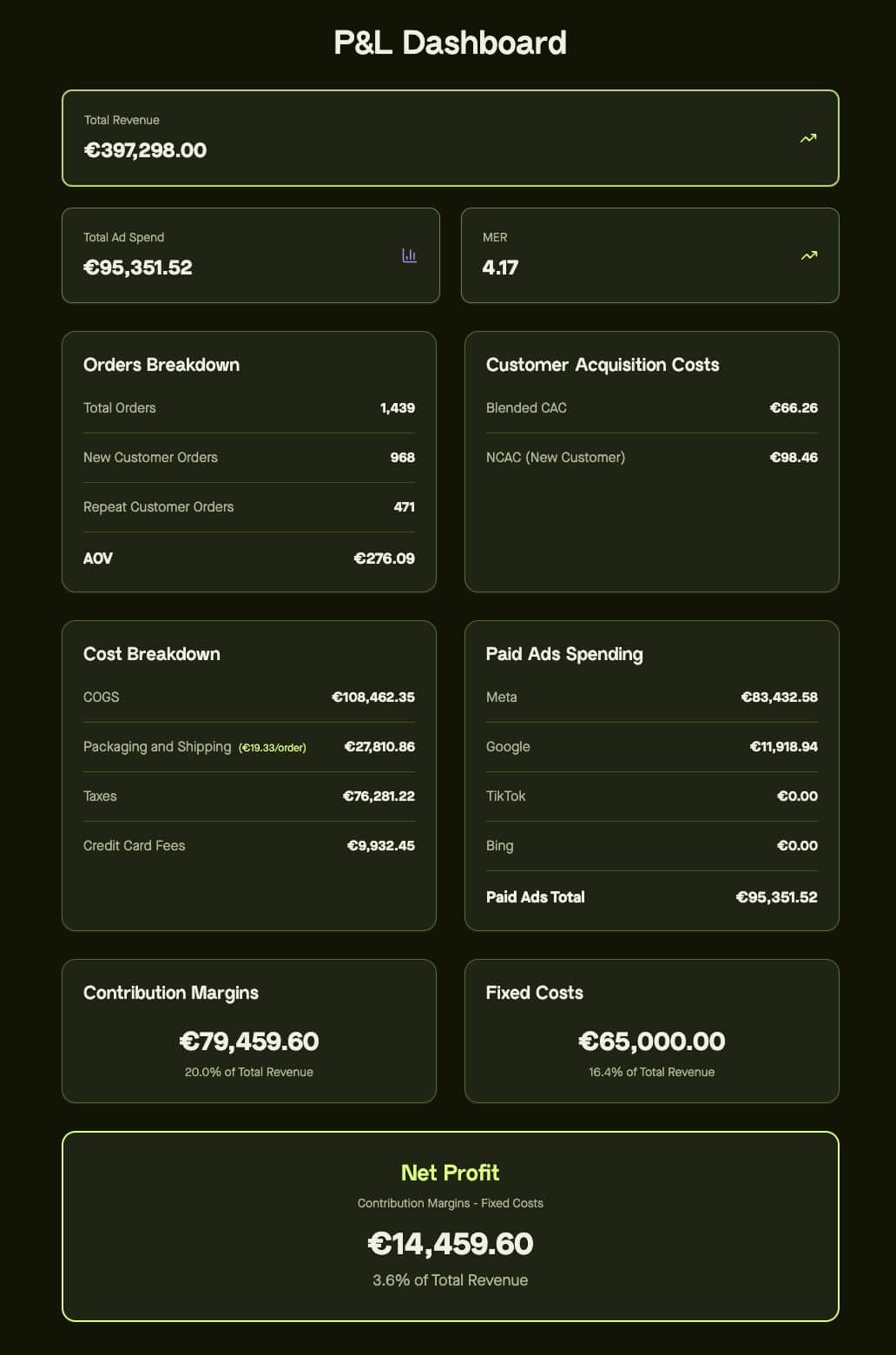
The P&L Breakdown
↳ Total Revenue: €397,298
↳ COGS: €108,462 (27.3% of revenue)
↳ Packaging & Shipping: €27,810 (€19.33 per order)
↳ Taxes: €76,281
↳ Credit Card Fees: €9,932
↳ Paid Ads: €95,351 (24% of revenue)
↳ Fixed Costs: €65,000 (16.4% of revenue)
Contribution margin after variable costs: €79,459 (20%)
Net profit after fixed costs: €14,459 (3.6%)
Here’s What I See
The paid ads are doing well.
24% of revenue on advertising with a 4.17 MER is solid. There’s maybe 1-3% to optimise here, but not much more. This isn’t where the problem lives.
According to industry benchmarks for DTC fashion brands, MER values above 4.0 typically indicate efficient customer acquisition. This brand’s advertising performance is actually outperforming most comparable operations in the €300K-500K monthly revenue range.
Problem #1: Fixed Costs Are Killing Them
16.4% of revenue going to fixed costs is way too high for a pure DTC brand on Shopify.
A lean DTC operation should keep fixed costs under 10%. This brand is 60% over that benchmark.
That’s €25K/month in excess overhead eating into profit.
For context, successful Shopify-native brands like Gymshark maintained fixed costs below 8% of revenue during their high-growth phase from $1M to $10M. The difference between 16% and 10% fixed costs isn’t just about efficiency; it’s the difference between survival and scalability. Every percentage point of fixed costs above 10% eliminates your ability to weather a bad month or invest in new inventory.
Problem #2: The Margin Structure Is Too Tight
COGS at 27.3% means they’re either underpricing their products or their production costs are too high for their market positioning. (Depends how you want to look at it.)
When you layer on shipping, fees, and taxes, you’re left with a 20% contribution margin.
That’s barely workable. A 25% contribution margin would give them room to breathe.
The math here is unforgiving. With a 20% contribution margin, this brand needs to be perfect everywhere else just to break even. One unexpected cost increase, one platform fee hike, one shipping rate adjustment, and they’re underwater. There’s no defensive moat.
The Real Issue
At 3.6% net margin, this brand cannot reinvest properly.
They can’t buy more stock. They can’t test new products. They can’t build a buffer for a bad month.
They’re running to stand still.
To have a healthy, growing fashion brand, you need 10-15% net profit minimum. That gives you the cash to reinvest in inventory; the lifeblood of any fashion business.
How to Fix This Fashion Brand: The Three-Step Approach
First: Test Price Increases Strategically
You can’t raise prices across the board. Too risky. You don’t know your price elasticity.
So we test.
Pick specific markets first. See how it goes. Then roll out slowly.
The goal: 50-55% margins after all variable costs. That gives you room to grow.
The conversation with the founder: “We either increase prices or you’ll never profit here. Better to find out if your products have a market at the correct price.”
Results are almost immediate. If tests hold, new pricing rolls out in weeks.
Second: Cut the Bad Hires
16.4% fixed costs for a DTC Shopify brand means one thing: too many people not moving the needle.
The problem isn’t software or logistics. It’s headcount.
Every person on payroll must generate more revenue than they cost, or they’re actively preventing growth. At this revenue level, a team of 3-5 is standard. Anything beyond that needs ruthless justification.
Third: Optimise Paid Ads (But Not the Priority)
24% of revenue with a 4.17 MER is solid. Maybe we shave 1-2%. But the upside is small.
This is a “later” lever.
What About COGS?
Not yet.
This brand is not big enough to renegotiate. That comes with more scale.
Timeline and Expected Results
Both fixes show results within 2 months.
Enough to shift from 3.6% to 10%+ net margin and double revenue in 12 months.
The margin is there. It’s just trapped.