
I recently audited a fashion ecommerce brand and what I found is something I see over and over again in this industry: high revenue, almost zero profit.
These are real February 2026 numbers from a brand we audited at Grapefox. Let me walk you through them.
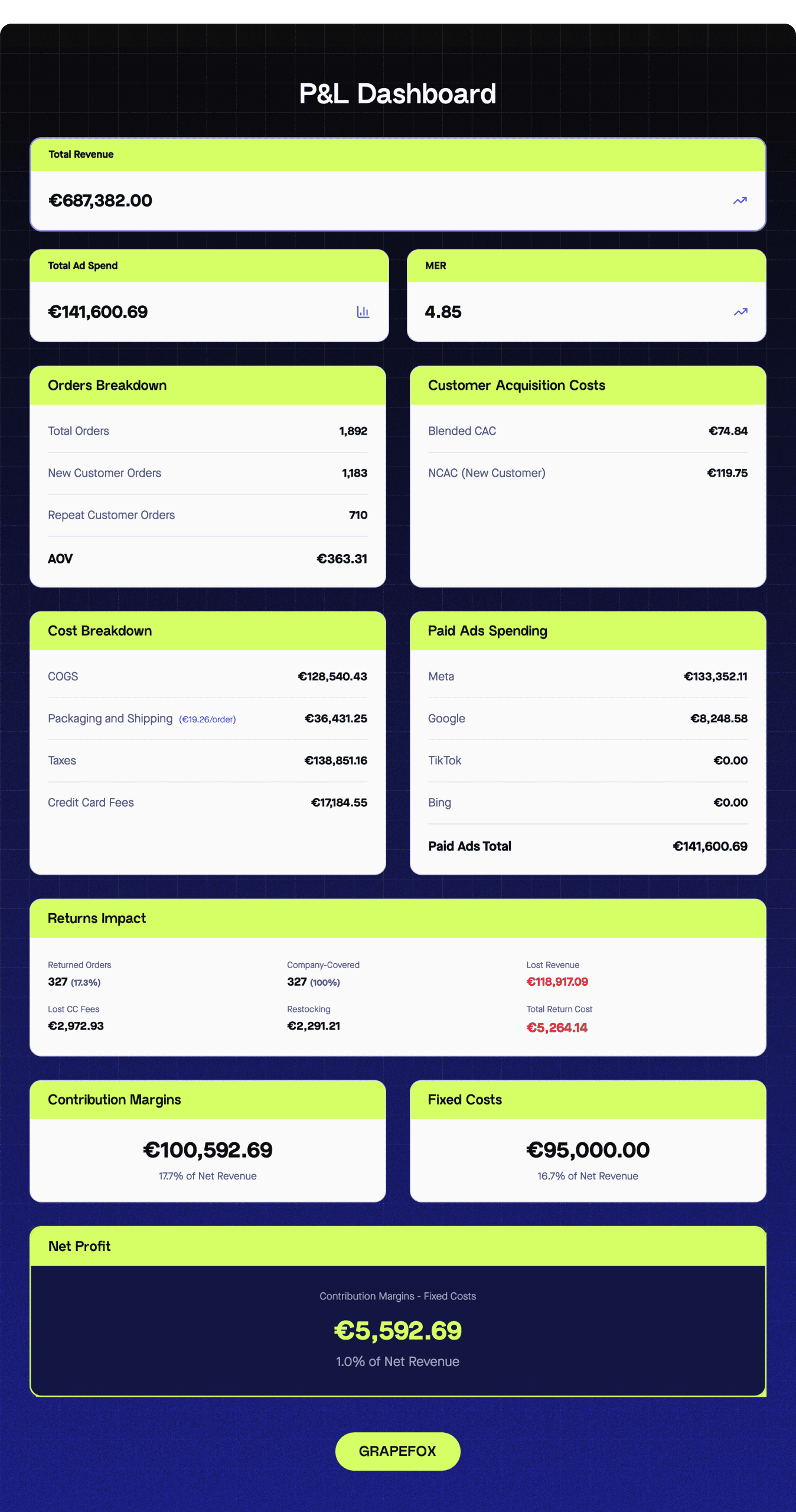
The Top Line Looks Great
The headline numbers would make any founder feel good:
→ 687K in total revenue
→ 1,892 orders
→ 363 AOV
→ MER of 4.85
Most founders would look at this and think things are going well. They’re not.
Here Is Where It Falls Apart
→ COGS: 128,540
→ Packaging and shipping: 36,431 (19.26 per order)
→ Credit card fees: 17,184
→ Paid ads: 141,600 (94% on Meta alone)
→ Returns: 17.3% return rate; 118,917 in lost revenue
→ Fixed costs: 95,000 (16.7% of net revenue)
About those returns. This brand covers 100% of them. No restocking fees. No partial refunds. No policy that protects them. Every return is fully absorbed.
327 returned orders. 2,972 in lost credit card fees and 2,291 in restocking costs.
This is not unusual. Industry data shows that online apparel orders have roughly a 25% chance of being returned, and retailers lose between 21 and 46 dollars per returned product after accounting for shipping, processing, and handling. At 17.3%, this brand is actually below the fashion average; the problem is their return policy, not the return rate itself.
The Margin Trap
After all variable costs, contribution margin is 100,592 (17.7% of net revenue).
Then fixed costs eat almost all of it.
Net profit: 5,592. One percent.
For context, fashion retail typically operates on net margins between 2% and 10%. The brands that reach 10 to 15% net (after all fixed and variable costs) are already performing at a very high level. Anything above 15% is rare; usually reserved for luxury houses or brands with exceptionally strong positioning and operational discipline. Even hitting 10% consistently on this kind of revenue would be an excellent result. One percent is not a margin; it is a rounding error.
And this is just the P&L. When you factor in payment terms, inventory purchases, and slower months, they are actually losing money. Break even on paper means negative in reality.
This Is Self-Inflicted Damage
Every single one of these problems is fixable.
I work exclusively in fashion, but I get approached by other sectors too. Across all of it, fashion is one of the hardest industries I have seen.
Very few brands actually make money. The majority generate serious revenue and keep almost none of it.
It makes sense. Running a fashion brand means managing production, logistics, stock, marketing, website, customer service, wholesale, retail, cash flow, and finance. All at the same time.
I sometimes joke that my clients are my worst enemies when it comes to selling my services, because I depend on their ability to run a healthy enough business to afford hiring me.
The Bottom Line
A brand doing 700K a month should not be making 5,500 in profit. That is not a revenue problem. That is an operations problem.
If your P&L cannot survive a slow month, you do not have a business. You have a machine that runs on hope.
At this point, is it even worth the stress? Personally, no.
Fixed costs at 16.7% of revenue need to come down to under 10%. The return policy needs restructuring. Ad spend allocation (94% Meta, 6% Google, 0% everywhere else) needs diversification. These are not complex fixes. They are decisions that require discipline.
The revenue is there. The profit is not. And that is the most common story in fashion ecommerce.