
Someone asked me last week if they should use a 3PL for their fashion brand.
Their concern? They’d pay a bit more per order and lose “full control” over logistics.
I hear this constantly. And I get it. The idea of handing over your warehouse to someone else feels risky.
But here’s what most founders miss: the real risk is keeping logistics in-house.
Let me explain.
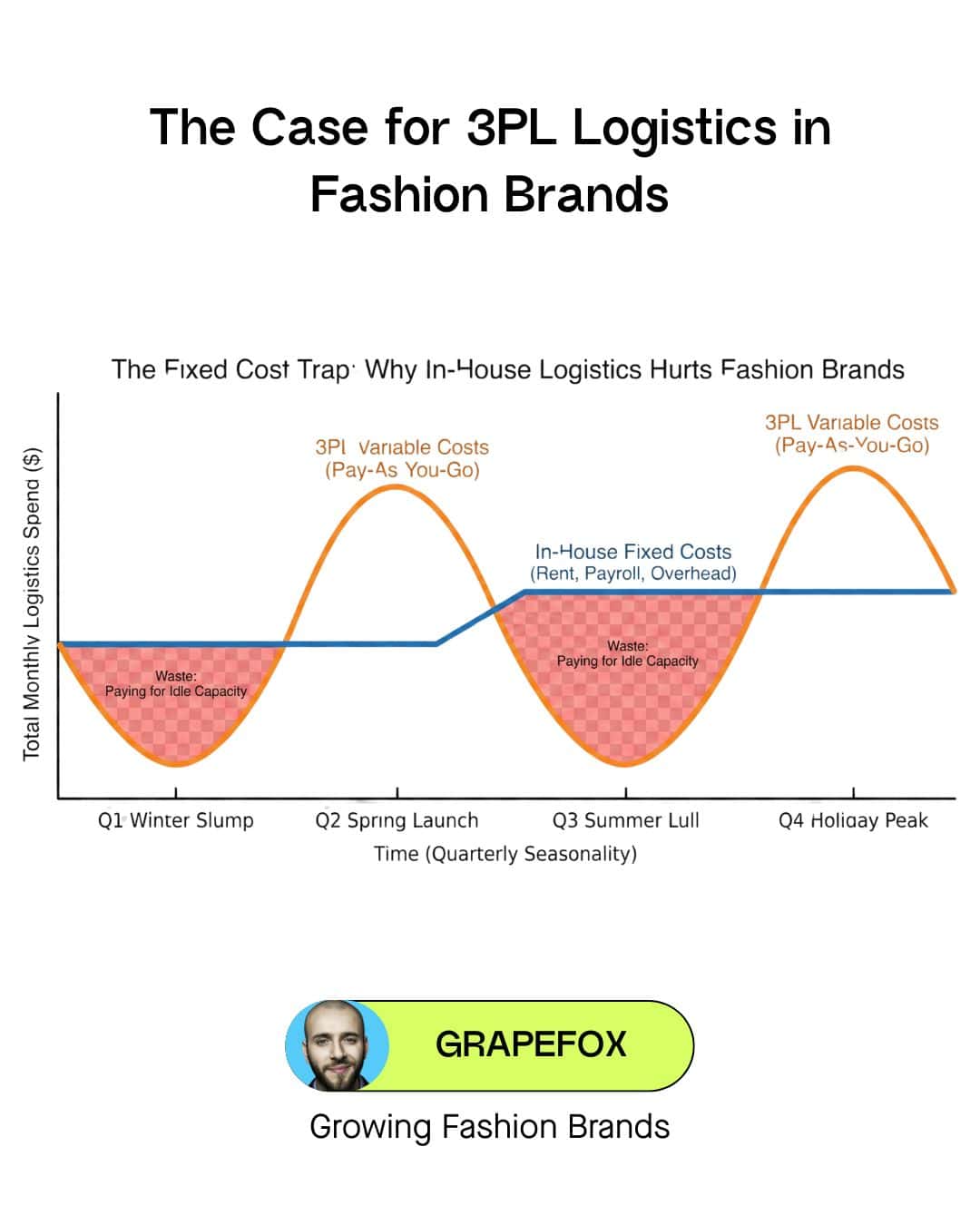
The Fixed Cost Trap
When you run your own warehouse, you’re locked into fixed costs.
Rent. Payroll. Equipment. Insurance. Utilities.
These bills show up every single month, whether you ship 10,000 orders or 1,000.
A 3PL flips this equation entirely. Industry data shows that in-house logistics creates fixed costs regardless of demand, while 3PL fees are mostly variable; you pay only for the space, services, and resources you actually use at any given time.
Think about what that means for a fashion brand with seasonal swings.
→ Summer collection launches and orders spike by 300%? Your 3PL scales up instantly.
→ January hits and sales drop by half? Your costs drop too.
With your own warehouse, you’d still be paying full rent and keeping staff on payroll during those slow months. That idle capacity eats directly into your margins – and this is why a lot of fashion brands lose money.
The Under-Utilisation Problem (and Its Opposite)
Here’s the part that really stings.
Fashion is unpredictable. One month you’re scrambling to keep up with a viral TikTok moment. The next month, crickets.
When you manage your own logistics, you’re stuck in one of two painful situations:
→ Sales drop unexpectedly and you’re paying for warehouse space you’re not using. Your team is twiddling their thumbs. Your fixed costs stay fixed.
→ Sales explode and you literally cannot ship fast enough. You miss delivery windows. Customers cancel. You watch revenue walk out the door.
This is the cost of opportunity lost, and it’s expensive.
A 3PL spreads this volatility across dozens (sometimes hundreds) of clients. When your sales dip, their other clients might be peaking. They absorb the fluctuations so you don’t have to.
The Shipping Rate Advantage
Here’s something founders consistently underestimate.
3PLs negotiate shipping rates based on massive aggregate volume across all their clients. You’re negotiating based on your volume alone.
The difference? Many fashion brands report 15-25% savings on shipping costs simply by switching to a 3PL with strong carrier relationships. Some providers even promise savings approaching 40% on logistics expenses through optimised networks and volume discounts.
Could you theoretically save a few dollars per order by doing it yourself? Maybe.
But factor in the warehouse lease, the staff salaries, the equipment maintenance, the software subscriptions, the insurance, the training, the management overhead…
Even if you save on the per-order cost, the total picture rarely makes sense unless you’re operating at massive scale with extremely predictable volume.
Cash Flow Is Everything
This one gets overlooked constantly.
Running your own logistics means upfront capital. Warehouse deposits. Equipment purchases. Payroll before you’ve shipped a single order that month.
With a 3PL, you typically pay as you go. Weekly or monthly. Based on actual usage.
That’s cash staying in your pocket, available for inventory, marketing, product development; the things that actually grow your brand.
For a fashion brand where cash flow can make or break a season, this flexibility is worth far more than the perceived “savings” of doing it yourself.
The Control Illusion
“But I’ll lose control.”
Will you though?
With the right 3PL, you gain visibility through real-time tracking dashboards. You get dedicated account managers. You maintain control over the customer experience through custom packaging and brand guidelines.
What you’re actually giving up is the “control” over fixing a broken conveyor belt at 2am. The “control” over managing warehouse staff turnover. The “control” over negotiating with carriers who know you need them more than they need you.
That kind of control? You should want to lose it.
The Bottom Line
The question isn’t really “3PL vs in-house.”
The question is: where should your time, energy, and capital go?
If the answer is “building an incredible fashion brand,” then logistics probably shouldn’t be your problem to solve.
Let the specialists handle it and keep your costs as lean as possible.