
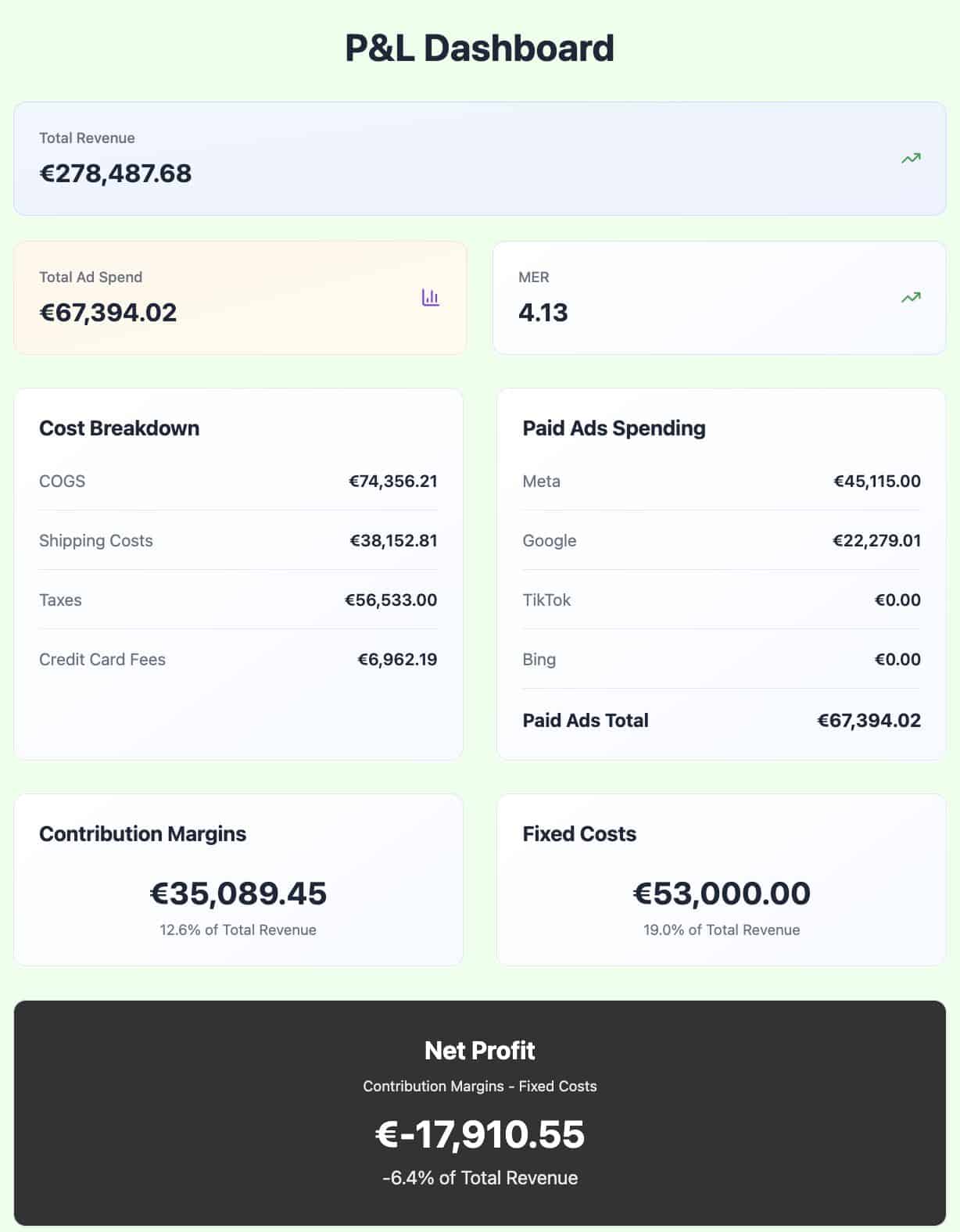
A fashion brand from Spain. Almost €300,000 per month in revenue through e-commerce. 95% of sales are DTC. No marketplaces, no retailers, no wholesalers.
Sounds like the dream, right?
Except they’re losing money. A lot of it.
This is a problem I keep seeing over and over again, especially with brands that got too much money from VCs or investors: they throw cash out the window.
The “Lean” Lie
In the discovery call I had with them, even before doing the audit, I asked about their fixed costs.
Their answer? “Oh, we cut costs by a lot. Now we are lean…”
Lean.
What does that even mean?
For them, spending €53,000 per month on €278,000 revenue is lean. That’s roughly 19% of revenue going to fixed costs alone. In reality, that’s completely insane for a pure DTC operation.
Here’s what the data says: DTC channels typically generate gross margins exceeding 60%, compared to 40-45% for wholesale. The whole point is that you cut out the middlemen and keep more money. But if you blow it all on bloated overheads, you’ve wasted the primary advantage of selling direct.
The Simple Math They’re Missing
In their case, it would be totally possible to keep fixed costs under 10%.
If they spent €25,000 instead of €53,000, they’d already be profitable. Around €11,000 per month in profit. Not an insane amount, but way better than losing €200,000 per year.
That’s the difference between building a sustainable business and slowly dying.
The DTC Advantage (That Most Fashion Brands Ignore)
Here’s the beauty of being DTC only: you can keep your costs extremely low. The entire business model is built around eliminating middlemen and maintaining control. But that control only matters if you use it wisely.
Here’s how to actually run lean:
↳ Use a 3PL to handle logistics so it becomes a variable cost. When sales dip, your costs dip with them. You’re not paying for warehouse space you don’t need.
↳ Keep your staff at a minimum and avoid overheads. Every full-time hire should be absolutely essential. If they’re not directly driving revenue or keeping operations running, question the role.
↳ Use freelancers where needed or hire overseas. Places like the Philippines offer lower rates with people who have perfect English. You get quality work without the fixed cost burden.
↳ Use Shopify to manage the website. It’s battle-tested, scales with you, and costs a fraction of custom solutions. No need to reinvent the wheel.
And all of a sudden you’re selling millions per year, with almost nothing in fixed costs.
Proof It Works
I’ve seen fashion brands making tens of millions per year in revenue with a super compact team: founder plus 6 full-time employees and a bunch of freelancers.
That’s it.
Look at Gymshark.
They hit £100 million in revenue within four years while operating on a lean, direct-to-consumer model. Ben Francis started in a garage with a sewing machine. The company prioritized variable costs, outsourced manufacturing, and kept the core team tight. That asset-light approach is exactly why they thrived; even during the pandemic when traditional retailers collapsed.
On the other hand, you have bloated teams wasting money that refuse to cut costs and become more efficient. They hire ten people to do what three could handle. They lease fancy offices. They build custom tech stacks instead of using proven tools.
Being obsessed with “DTC” and then throwing away its biggest advantage should never happen.
The whole point is to be lean. If you’re not, you’ve missed the plot entirely.